
Precision maritime simulation
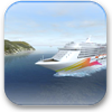
Ship Simulator is a PC-based maritime vehicle simulation mission-based navigation loop centered on vessel handling, route execution, and scenario objectives. The game runs on Windows systems and models civilian and specialty ships through parameter-driven control sets and physics rules. Core operation combines ship control systems, environmental physics modeling, and scenario scripting to govern each session.
Ship Simulator missions load into predefined geographic maps representing real ports and regions, where weather conditions, wave intensity, and traffic variables are dynamically applied. Progress is tracked through mission completion states and unlockable vessel access rather than an open economic management layer.
Ship Simulator maps vessels to distinct control schemas, including throttles, rudders, thrusters, and towing gear. Response curves vary by class, depending on mass and inertia variables. Movement utilizes hydrodynamic physics, accounting for wave force and momentum. Collision detection employs rigid-body boundaries, with damage and failure triggers defined per mission. This system prioritizes real-time handling over persistent vessel-wear, ensuring each session remains a standalone technical challenge.
Nautical precision
The mission framework loads structured objectives like docking, rescue, and cargo transfer. Scenarios define start coordinates, traffic density, and weather presets. Objectives are evaluated via checkpoint triggers and rule validation rather than adaptive outcomes. However, mission branching remains limited, with resolution tied to fixed success conditions. While free-sail modes exist, they reuse environment maps and physics stacks without persistent world-state progression or economic evolution.
The environment engine applies wave spectra, wind vectors, and visibility modifiers that alter vessel response. Storm presets increase force coefficients and deck instability. Ports are bounded maps with fixed navigable zones and predefined traffic paths. AI vessels follow route scripts with collision avoidance but no behavioral adaptation. Environmental assets remain static, and the system lacks persistent vessel-condition tracking, resulting in consistent but non-evolving sessions.
Master the helm
Ship Simulator operates through mission-driven vessel control, parameterized ship physics, and scripted maritime scenarios across fixed global port maps. Its structure combines hydrodynamic motion rules, scenario validation triggers, and weather-force modifiers. System constraints include fixed mission branching, non-persistent vessel state, and route-scripted AI traffic. Environmental layouts and traffic logic remain static across sessions, and progression depends on scenario completion rather than on an open, systemic economy.
Pros
- Parameter-driven ship control models
- Hydrodynamic force and wave interaction system
- Scripted mission scenario framework
- Dynamic weather-force modifiers
Cons
- Fixed mission branching structure
- No persistent vessel condition tracking